

A successful star throughout the ’70s, Rakhee’s roles became more diverse as soon as the ’80s began. Apart from playing the leading lady, she was also seen in maa and bhabhi parts. By the later part of the decade, the actress had completely moved on to mother roles.
Some of Rakhee’s most well-known mother roles in the ’80s and the ’90s hinged on a certain trope that became almost exclusive to her. The actress would invariably be seen playing a wronged woman who suffers harrowing humiliation at the hands of the antagonist(s), and this becomes the trigger point for the revenge quest that often her son (the film’s hero) sets on.
It began with Rahul Rawail’s Dacait (1987) which tells the story of how upper caste atrocities and corruption force an educated young man to take up arms. Rakhee plays the upright mother and a respected village elder who suffers cruelly at the hands of the oppressive zamindaar for opposing his injustices. In its most unsettling scene, Thakur and his men wreck havoc on the protagonist Arjun’s family on his younger sister’s wedding day. Hung from a tree, he watches helplessly his older brother getting murdered, his sister driven to her death, and his mother disgraced in public — her hair cut off and forced to dance to the beats of the wedding dhol — go insane at the unbearable turn of events. The misogynistic targetting of women in this scene is telling of how casually the oppressors employ violence against women to exert control over the oppressed. Arjun, as much as he is anguished by this ordeal, it’s his mother’s humiliation and subsequent mental breakdown that sets him on a path of vengeance.

The viciousness Ram Lakhan‘s (1989) Sharda faces hardens this good-natured woman to seek retribution from those who did wrong by her and her family. Sharda’s husband is tricked by his cousins Bhishambhar and Bhanu and loses their ancestral home and property. Sharda is accused of stealing, dragged by her hair and thrown out of the haveli by Bhishambhar while her younger son looks on petrified. She endures this shame for the sake of her family’s safety but when Bhishambhar and Bhanu kill her husband brutally in front of her eyes, something shifts within Sharda. She cremates her husband with his blood splattered on her face and clothes. Later on, she washes the blood off her, dons black, and vows not to immerse his ashes until her sons have extracted revenge from their father’s killers. The scar on her forehead is a reminder of the horrors Bhishambhar inflicted on her and her loved ones and she spends the rest of her life awaiting the ruin of her tormentors.
The fate of Durga in Karan Arjun (1995) isn’t very different from Sharda. She raises her sons within limited means after having been excluded from her late husband’s ancestral property by his conniving cousin, Durjan. When Shrada’s dying father-in-law tries to make amends with her and offers her boys their share of the inheritance, Durjan ruthlessly murders them. Mad with grief, Durga vows that her sons will be back to avenge the injustices meted out to them. For years, she waits for them to return and her claim is met with abuse and ridicule from Durjan and his cohorts who brand her a senile old woman. This reincarnation potboiler became one of the most recognized roles for Rakhee and her famous proclamation “Mere Karan Arjun aayenge,” a much-imitated element in desi pop culture.

In Hindi cinema, the dishonour of a female family member is always seen as a tipping point in the hero’s revenge path and Bollywood has notoriously exploited this trope to the point of producing some awfully sensationalist and misogynistic story lines during the ’80s and the ’90s.
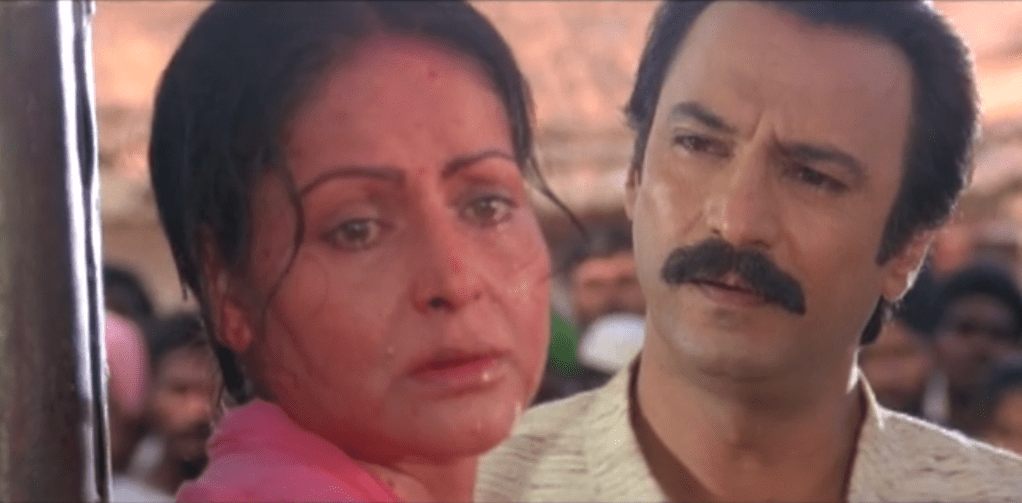
One such intensely horrid scene unfolds in the 1993 hit Anari, a remake of Tamil blockbuster Chinna Thambi (1991), where Rakhee plays the widowed mother of the film’s protagonist. Savitri is tortured by the powerful zamindaar’s family for her absconding son Rama’s whereabouts, who they believe has married their younger sister in secret. In order to extract information, the Thakur and his brothers intimidate her and publicly humiliate her in the crudest manner. She’s dragged out of her house, tied to a pole, and the whole village is threatened to watch her humiliation silently. Thakur’s men douse her white saree in colours; she’s made to wear red bindi and flowers in her hair akin to a new bride while Thakur taunts her with innuendos hoping this indignity will break her. A shaken Savitri remains defiant even as the Thakur tries to marry her off to a mentally unstable man and that’s when Rama bursts into the scene and makes the perpetrators pay for their misdeeds. Savitri’s harassment gets more unsettling because it perpetuates the notion that ‘disrespecting a woman is challenging a man’s masculinity’ in the most offensive manner. For scenes such as this — common to that era — it was not uncommon to observe that the man’s rage found precedence over the woman’s trauma.
The same year Rakhee played yet another wronged woman in Abbas Mustan’s now iconic Baazigar (1993). A young Ajay witnesses his father getting defrauded by his unscrupulous employee, Madan Chopra, who also disgraces and propositions Ajay’s mother Shobha (Rakhee). As Ajay’s family struggles in penury, his father and infant sister succumb to death under the most heartbreaking circumstances. A traumatised Shobha loses her mental acuity and Ajay has to assume all responsibilities for him and his mother. Harbouring a deep desire for retribution, Ajay bides his time to beat Chopra in his own dirty game to reclaim his mother’s identity and everything that’s rightfully his.

The disparaging “mera baap chor hai” tattoo on Vijay’s arm — a vile, haunting reminder of the humiliation that one of the protagonists of Yash Chopra’s classic Deewaar (1975) endured in his boyhood — holds an iconic position in Hindi cinema history. Years later, Abbas Mustan made an audacious attempt of inverting this plot line in their 1998 hit Soldier where a woman bears the insignia of humiliation and lives a cursed existence; she’s shamed for her husband’s alleged treason and banished from the society. And who else to play the part of the tormented woman, Geeta to perfection but Rakhee? Like Baazigar‘s Ajay, Soldier‘s Raju, too, witnesses the downfall of his family and follows an unconventional path to punish those responsible and restore his abused mother’s dignity. The story unfolds like a mystery leading up to a shocking and emotionally charged climax where the extent of Geeta’s suffering is revealed manifesting Raju’s motive all along.

Soldier was perhaps one of the last ’90s masala film successes. It was also the last major mother role Rakhee appeared in. In the next few years, she cut down her acting assignments. Her last release was Rituparno Ghosh’s Shubho Mahurat (2003) where she plays the observant aunt of a journalist who helps crack a murder case. The actress made a comeback only a decade and a half later in another Bengali film Nirban in 2019. At the turn of the new millennium, Hindi cinema, too, started moving away from the formulaic fare to more relatable stories and milieu. Long suffering mothers, selfless bahus, avenging sons, evil ‘jaaydaad ka bhookha’ uncle — once stock characters of Bollywood — now remain vestiges of a time gone by.
 Flashback Bollywood